Crossing the Lines: Highland Park was once home to diverse Muslim communities
Drawn to the area by Ford Motor Co., Muslims built one of the United States’ first mosques from the ground up in Highland Park. It was only open for about a year before its congregants began heading to Dearborn.
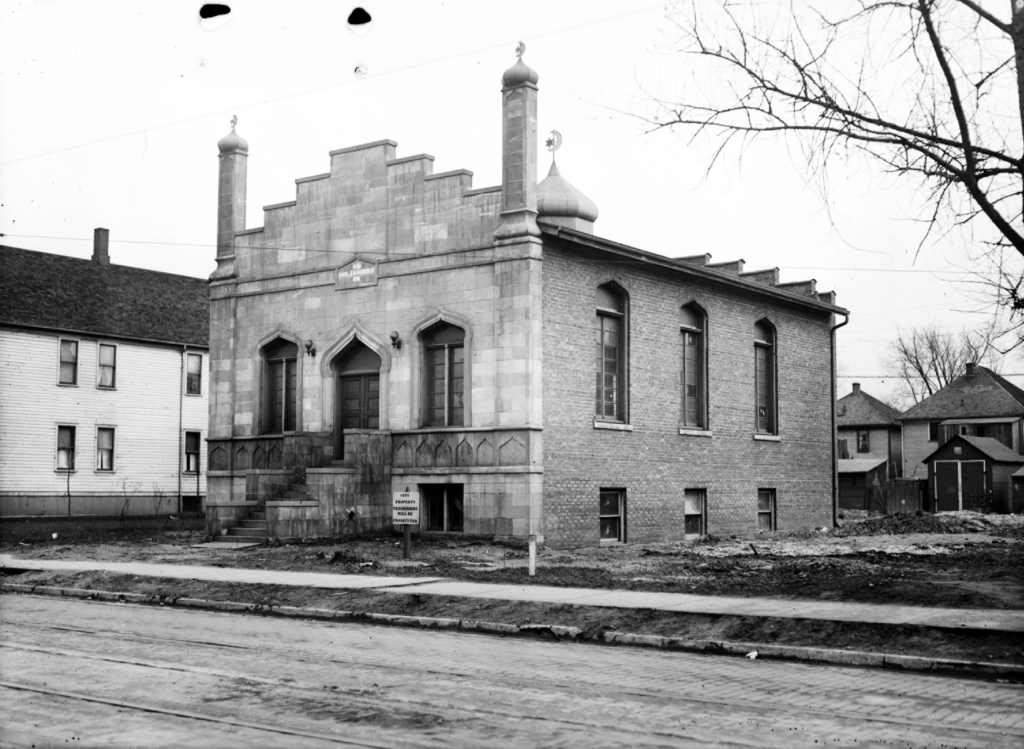
Highland Park Mosque was one of the first mosques built in the U.S.
While the city of Highland Park may be known as the birthplace of the automotive assembly line, it’s also home to one of the first mosques built from the ground up in the U.S.
Imams Hussein Karoub and Khalil Bazzi led the construction of Highland Park’s Moslem Mosque. They selected a location near the Ford assembly line plant in Highland Park and opened the mosque in 1921.

Sally Howell is a professor of history at the University of Michigan – Dearborn. She says Syrian immigrants, “mostly from what is today, Lebanon,” built the mosque.
She says immigrants were attracted to the Ford plant’s wages of $5 per day, which was around twice the average industrial wage at the time.
She says Arab Americans had organizations and political associations leading up to mosque opening. Howell says people from the Middle East, South Asia, and Eastern Europe worshipped there. It only stayed open for about a year.
“Part of the congregation, by 1921 had already started moving to Dearborn, because Henry Ford was already building and starting to open the Ford Rouge assembly,” she says.
However, Highland Park had a growing African American Muslim population.
Imam Hamidullah Daniel Mujahid was born in Highland Park in 1953.
He says many Muslims practiced their faith in private during the 1950s and 1960s. About 50 Muslim families—people from the Middle Eastern, followers of the Ahmadiyya movement from South Asia, and people from the Nation of Islam—lived in the city.
“At this given point in time, the only outward practicing group was the group that was called the Nation of Islam, that was the Black African American community,” he says.
Mujahid says people wanted to fit in with the majority of the Christian population. They also didn’t want to get targeted.
Researcher Akil Fahd says another predominantly African American mosque, Masjid As-Salaam, opened around 1971. It was an incubator for other mosques.
“A lot of the other communities that were Sunni Muslim, that did not come out of the Nation of Islam, they kind of spread out from Masjid As-Salam,” he shares.
A lasting community
Masjidun-Nur opened in 1977 on Pilgrim Street. It has an extension building, the Markaz Al-Tabligh, on Hamilton Avenue for larger gatherings and special occasions such as Eid prayers.
Fahd says it’s part of the Tablighi community, a global Islamic missionary movement focused on spiritual renewal, prayer and following the teachings of the Prophet Muhammad (peace be upon him).
Fatimah Rashad is a labor and delivery nurse and mom of four. Her parents moved from New Jersey to Highland Park in 1991.
“My father actually wanted to move here because it’s a bigger Muslim community, and they heard about the Islamic schools,” she says.
Rashad says the community was warm and welcoming. About 20 families lived there.

Khalil MuMinun is an assistant imam at Masjid Wali Muhammad. He says the Muslim community in Highland Park offered an alternative lifestyle.
“They played a significant role in you know keeping the drug epidemic from taking over the entire neighborhood by creating a space where the standard was virtue and having good manners with your neighbors,” he explains.
While today just a few Muslim families remain in Highland Park, Muslim communities played a vital role in developing the city since the early 1900s.