This interview originally aired on “Marketplace Morning Report” on Oct. 23. Listen to the “Marketplace Morning Report” each weekday at 6:51 a.m., 7:51 a.m. and 8:51 a.m. on WDET.
As part of our Economic Pulse series, “Marketplace Morning Report” checks in with journalists from local public media outlets across the country to hear about the economic stories they’re following in their communities and states.
This week, “Marketplace Morning Report” host Kimberly Adams spoke with Robyn Vincent. She’s the host and producer on WDET’s “The Metro” in Detroit.
She came on the program to discuss how the trade war with Canada is impacting the Michigan economy — plus some fights over data centers and high utility bills in the state. The following is an edited transcript of Kimberly and Robyn’s conversation.
Kimberly Adams: So, tariffs are a huge story where you are in Detroit. The Trump administration has imposed 50% tariffs on certain Canadian goods. You have so much commerce back and forth across the border there in Michigan. How have these tariffs affected the Michigan economy?
Robyn Vincent: Yeah, Kimberly, Michigan is hit harder than most states, and the short answer to why that is is that we’re on both ends of this. So, Michigan buys more auto parts from Canada than any other state and ships them more than any other state. So, we get taxed coming and going. I spoke with Jason Miller, who studies supply chains at Michigan State University, and he told me so far, it’s showing up in jobs more than in prices. He said importers have absorbed most of the tariffs rather than raise prices, but Michigan has lost about 4,000 jobs when it comes to people who are making auto parts in the last year, and that’s according to the state’s automotive dashboard.
Adams: The automotive industry is not the only one feeling the pinch. There’s also the tourism industry. How has that been affected?
Vincent: Yeah, I mean something you have to remember, Kimberly, is Detroit is a border town. Windsor, Ontario, sits directly across the river from downtown Detroit.
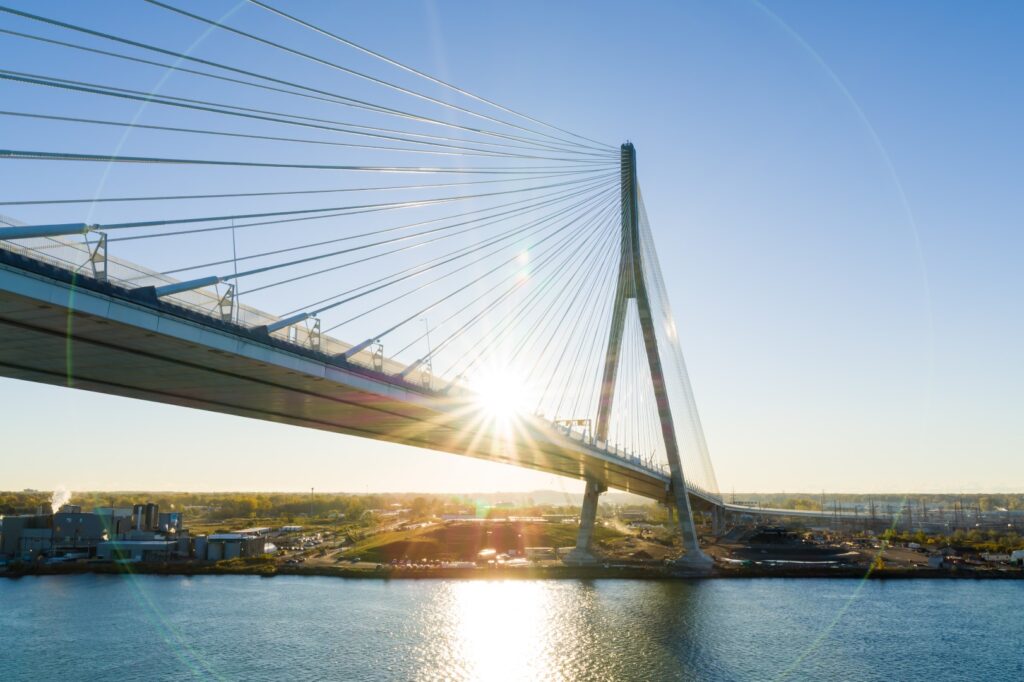
In July, a new bridge opened between Detroit and Windsor. It’s the longest bridge of its kind in North America. Canada paid for nearly all of it, close to $5 billion. Now, here’s what’s very telling about that: the two countries were supposed to cut the ribbon together. Canada called that off. They held their own ceremony on their side of the river and pointed to the president’s tariff threats.
A lot of Canadians are likely to not use this new bridge. Visit Detroit, the regional tourism bureau, tells me that visitation from Canada has been running about 30% below normal since 2025. But I’ve talked to local business owners who feel that number is much lower. That there are many more Canadians who are choosing not to cross over, not to spend their money in Detroit.
I went to Eastern Market — that’s Detroit’s public market. It’s the place you go on a Saturday morning for fresh produce and artisanal cheeses and locally made goods like jewelry and leather handbags. Vendors there tell me their Canadian regulars have pretty much stopped coming.
Adams: We’re coming up on the midterm elections. How much are the issues of trade and tariffs and its impact on Michigan coming up with these candidates as we get down to the final days before voting?
Vincent: Yeah, they’re talking about it a lot. Democrat Abdul El-Sayed calls the president’s approach “chaotic,” “ham-fisted,” “self-serving.” He’s got the United Auto Workers behind him. Republican Mike Rogers says he’s ready to work with the president on the tariffs, the ones that are working at least, and he says that he’s ready to push back on the ones that aren’t.
They are both making their pleas to voters right now that they can make change, that they will be agents of change in this moment when so many voters are angry and want to see the tariffs and the trade war come to an end.
Adams: I want to shift gears now. Data centers have become a flashpoint across the country. How is that debate playing out in Michigan?
Views on data centers nationwide
Vincent: Yeah, it’s playing out in a few different places right now. Van Buren Township, which sits about 25 miles west of Detroit, is an area with farmland, subdivisions, and industrial parks, and so Big Tech has been eyeing it. And last week, it approved a Google data center that will draw a gigawatt of electricity. That’s about what 750,000 homes use.
The township and Wayne County are forgiving an estimated $125 million in local taxes over the next 12 years. Residents packed meetings for 10 months, asking the board to reject it. The township supervisor, Kevin McNamara, told my colleague Quinn Kleinfelter that he didn’t have the option to say no.
Kevin McNamara: A lot of them just don’t seem to understand that data centers are legal. They say, “just say no.” You can’t just say no. If you say no, you go to court, and the court decides what to do, and they decide how to build it. And as badly as maybe I didn’t want a data center, I’m not letting a judge in downtown Detroit build our data center. We’re going to build the best damn data center we possibly can.
Vincent: So that’s the argument he’s made to angry neighbors for 10 months, Kimberly.
Adams: Wow. Data centers are of course connected to utility bills, and the energy prices have been a story that we’ve been covering here on “Marketplace Morning Report” pretty much nonstop. How have Michiganders been feeling the price pressures?
Vincent: Yeah, utilities in Michigan are the highest in the Midwest, and in the city of Ann Arbor, there’s a ballot measure that would clear the path for the city to create its own utility. And this is in response to those high utility rates and also to frequent outages that many of us here in Michigan experience; it feels like every time the wind blows, honestly.
Here’s the thing, though. The Ann Arbor City Council just drafted a resolution that opposes that ballot measure, and residents are furious about this. I mean, people were seeing this ballot measure as a blueprint, if it passes, for other cities in Michigan to take on.
Adams: We are less than two weeks out from the midterm elections. Y’all have an incredibly contentious Senate race there in Michigan. Are data centers or these rising utility bills coming up on the campaign trail?
Vincent: They absolutely are. I mean, Democrat Abdul El-Sayed has a multi-point plan, we will say, on how he plans to deal with data centers. Republican Mike Rogers is also pushing for guardrails on data centers.
I would say one of the differences, though, between the two of them, Dr. Abdul El-Sayed says he wants to see money out of politics. And one of the reasons that many people feel utility rates are so high in Michigan is because DTE Energy gives a lot of money to many politicians in Michigan, and you know we have the receipts to back that up.