Perceived failures by the Trump Administration regarding affordability and immigration enforcement—plus the ongoing war with Iran—has led to very low approval ratings for the president. Yet, approval ratings for the Democratic Party are somehow still worse.
The Michigan Democratic Party recently held its nominating convention in Detroit and it wasn’t without controversy.
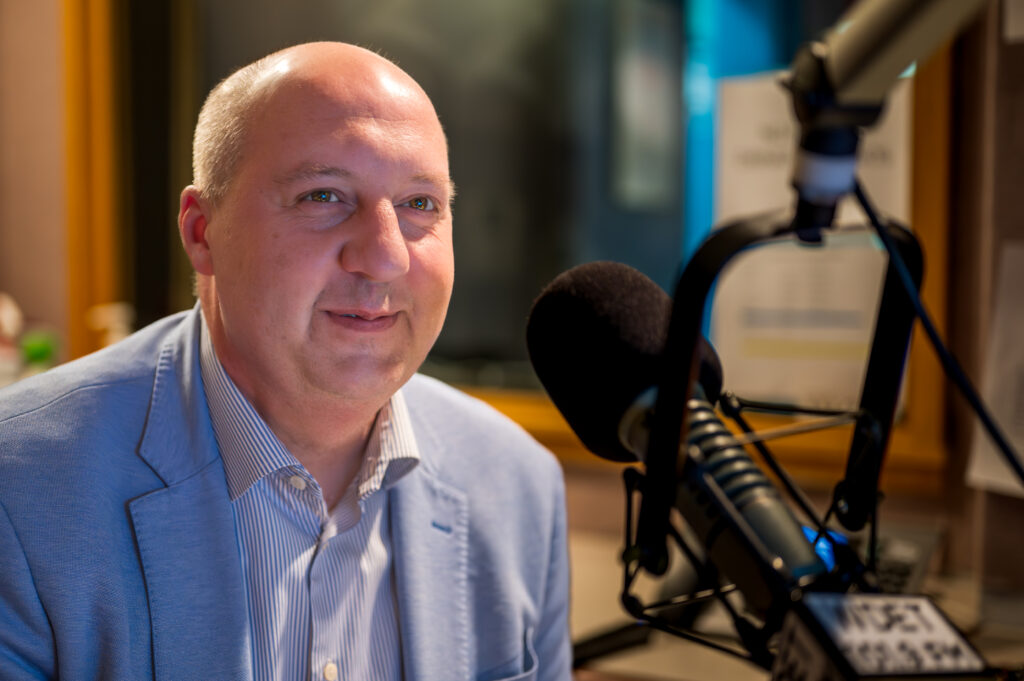
WDET’s Russ McNamara recently caught up with Party Chair Curtis Hertel, who took over leadership following the disastrous 2024 campaign cycle. He says he’s excited by most of what he saw at the convention.
The following interview has been edited for clarity and length.
Curtis Hertel: I think some of the best moments were people cheering for their candidates, and the energy in the room was, was really great. You know, some of the booing that happened and other things you know, were not my favorite part, and certainly are things that violate our code of conduct and everything else. But I think if you look at it as a whole, we walk out of convention with the united slate of candidates that I think are poised to win in November.
You have Eli Savit, who has a record of being a prosecutor… and was an environmental lawyer taking on corporations. And when you think about what’s the most important thing for the attorney general’s office, it’s a People’s Lawyer.
The powerful, the rich, the corporations—they all have access to lawyers. What we need is people that can actually fight for the people of Michigan, the People’s Lawyer, like Frank Kelly and Dana Nessel—
Russ McNamara, WDET: I wanted to ask you about that booing real quick. Where does that come from?
CH: There’s always going to be people who disagree. You know, we’re a big tent, and it’s important that there’s a place in the party for people that have differing views. I think we can differ respectfully. I think that’s the way it should be.
I think that Republicans behave in a way where they eat their own. We shouldn’t be doing that but, but I don’t think it’s the the few hundred people that were at convention that were doing that we’re not the representative of the 7,250 people who were there who were cheering the people on. And I think we’re united. So, you know, I understand it’s interesting to focus on things where but, but I think it was a small part of it was the noise, not the frequency of what actually happened at convention.
Primaries vs. conventions
RM: There’s been talk by some at the convention about changing to primaries and away from convention endorsements. Is that something you can get behind?
CH: So I’ve always supported that. When I was in the Michigan legislature, I supported that. Primaries are good. Discussions are good. We want people to be able to be part of the choices. A primary would be a better system, but you have to change the Michigan Constitution to do that. I don’t think it’s happening tomorrow.
RM: Why do you think there’s the push right now to get it done? Because there weren’t whispers of this eight years ago…
CH: I can’t speak for those that are talking about it now. I mean, you you might want to have them on the show, but, but I will say that I I’ve always supported the exact same position that more people should be involved in the decision making process and any decisions. I think the more people that you allow in your decision making process, the better that is, because they feel connected to it.
Right now, (Republican candidates) are in a game of ‘who can stand with Donald Trump the most’. Trump is the most unpopular president in the history of this country, who has raised the health care cost on everybody and cut taxes for billionaires that has used a war of choice and tariffs of choice to actually increase the cost for every single American.
I paid $4.20 for gas this morning in East Lansing, before I drove here. They promised people that tax that their lives would be better, that there would be America First, so they’d be sick of winning, that the cost of groceries would go down, that the cost of gas would go down, that they wouldn’t be focused on foreign wars, all of that’s going to lie and whether it’s the Epstein files that they haven’t released, or the foreign wars of choice that they continue to go into, or the focus on billionaires and their bottom line instead of the American people’s, they have lied to the people of Michigan, and I think we got a good story to tell.
How can Democrats work for working people?
RM: Affordability is set to be the big story for the midterm elections, but if Democrats win, what happens after? What’s the plan?
CH: The Democratic Party has to remember that we are the party of working people. And when you look at when Democrats had the trifecta in Michigan, we did things to lower the cost for people. We passed the largest tax cut for working families, brought 30,000 kids out of poverty and gave free breakfast and lunch for every kid. The largest investment in affordable housing in our history, the largest investment in lowering the cost of childcare, we have the record to do that.
We didn’t run on it.
So Democrats have a responsibility to both provide solutions, but also to talk about them to the electorate.
There’s a line Maya Angelou has. “It’s not what you do for people, it’s how you make them feel.” (Ed. Note: This quote in many paraphrased forms is often attributed to Angelou, but there’s no evidence she ever wrote or said it.) We didn’t have the conversation about the things that we had accomplished for people.
This generation right now is the slowest generation in American history to buy a house, to buy a car, to start a family. That is a long systemic problem that we have not fully solved, and I think it’s important to acknowledge that, but they’re only making it worse.
On the other side, there’s a line in the movie “The American President” that if you don’t give people water, they’ll drink sand. Trump is to blame. He is trying to pit people against each other in order to maintain power, but we got to give people water. That’s the history and the soul of who the Democratic Party is, and that’s what we have to do as we’re heading into after the elections.
RM: But there’s always that sense that Democrats are going to get into power and they’re going to raise taxes.
CH: I just told you—
RM: Yeah, but what’s the plan you’re talking about making people ‘feel’ alright…
CH: It’s important to acknowledge the fact that in Michigan, we actually lowered the taxes for most working families and brought 30,000 kids out of poverty. We’re the ones that ended the retirement tax. (Former GOP Gov.) Rick Snyder is the one that put it on. So I do think that there are good examples of that. At the end of the day, I don’t want to raise the taxes on any Americans, except for those that are in the top 1% that I think can afford to pay them in order to provide what is guaranteed to all of us, which is the life, liberty, and the pursuit of happiness.
“We’ve got to stop giving up on places.”
RM: So Democrats are reconnecting with the working class in Michigan. But you know, nationally, that seems like it’s a lesson from 2024. What else can you glean from that election?
CH: Here’s the thing, it’s not just a lesson from 2024 I want to be perfectly clear. We need to build a party that is not just survive on one election alone. Like, like, that’s part of the problem is that we didn’t learn the actual lessons in 2018 because we won. And to me, there’s, there are really important lessons that the Democratic Party has to learn.
Part of it is, we’ve got to stop giving up on places. I was in 32 counties last year working to do the work of a Democratic Party.
It’s hard to sell a Democrat from California in Kalkaska, but it is easy to sell people that are actually from that community. And so we’ve got to rebuild.
So it’s not just about redoing one election and trying to win one election, this is about the structural problem that we have got to refocus back and try to win everywhere. It’s why we have an office in Detroit, because a lot of times, people in Detroit felt like we had abandoned them, that we were showing up in September and asking for their vote. We’re in as part of the community now, because it’s important to do that work.
Trying to bring people together after losing trust
RM: There was a major rift within the Democratic Party about Israel’s war in Gaza. A lot of that affected Dearborn, Hamtramck—metro Detroit’s Muslim and Arab communities. How do you rebuild that trust? Because a lot of them either stayed home or ended up voting for Donald Trump because he was the “peace candidate.”
CH: So I was endorsed for chair by both the Jewish Caucus and the Arab caucus, because there is a real want and need to build spaces where people communicate together.
There’s not going to be a Democratic party where everyone agrees on every single issue that that that that is out there, but there has got to be room for people to have conversation and be able to find places they agree with.
So for example, on ICE and the changing of what ‘America’ means when we have immigrants actually carrying their own papers because they’re afraid… I met with an American citizen who carries his passport every single day because he’s terrified of being stopped in the street.
That’s something the Jewish Caucus and the Arab caucus agree on, and they work together on. I think that’s what’s really powerful, is actually finding the spaces of agreement between people. My job is not to decide where the Democratic party goes. That’s the people’s job. Like the idea that the chair of the Democratic Party is supposed to set the position for all these people is just nonsense.
RM: I’m talking about outreach, really. There was a lot of trust broken. I talked with a ton of people, and we had 100,000 people vote uncommitted in a primary that took place in Michigan.
CH: We actively avoided conversations. And that does not work. I’m spending a lot of time in the Arab community and the Jewish community right now, actually, because I think it’s really important that we actually provide a space.
And I think that really the biggest thing that I am trying to solve is that people have felt forgotten by the Democratic Party. And I can tell you that that’s why I was in 32 counties last year. It’s why I was at more iftars than I’ve ever been in my entire life last year. It’s why finding that space between people is so important, and showing up and being part of the conversation and listening, which I think is probably the most important part politicians and party people have a tendency to talk a lot, but not to listen a lot. So that’s what I’m I’m doing as chair of this party, trying to bring people together.
Democrats need to fight back
RM: You talked about Eli Savit and Garlin Gilchrist being fighters for Michigan.
CH: Yes.
RM: Is that in response to the perception nationally of Democrats not being fighters for what they want? Because there’s a reason why the Democratic Party has a very, very low favorability rating right now. From the people I’ve talked to, especially at protests, they don’t feel like the Democratic Party or Democratic candidates are doing enough to fight for what they want.
CH: I will say that my best days are when Democrats are fighting back. I think we had the most progressive six months in the history of Michigan, when Democrats had the trifecta. But I get it like people are frustrated and they’re angry, and I would say two things about that.
One, we should always push our leaders to do more, and I’m all for that, and that’s important. But I will also say that for each of us, we’re waiting for the calvary to come, and we have to realize that we are the cavalry.
We have got to do the work to change and take the Republicans out of power.
We do these things called “People’s Town Halls.” It’s my favorite thing that I do as chair. We go into Republican districts and we actually bring people in because they refuse to meet with their own constituents, and we listen to people and what they’re feeling and the anger and the frustration.
And I get that people want that to change, but I will say this: right now, unfortunately, Democrats are in minority in the house by three seats, and in the Senate. We can change at this election. Democrats do have to prove they’re willing to fight back, absolutely, but we got to get to the place where in the power to actually change that first. And I have full faith that, when I’m going around the state, that we have Democrats that are ready to go out and do that work.