
Crossing the Lines: Highland Park values enclave status
Detroit surrounds Highland Park on three sides, sharing the fourth side with Hamtramck. Being a city within a city is a source of pride for many Highland Park residents. As part of WDET’s Crossing the Lines Highland Park series, Morning Edition Detroit host Pat Batcheller looks at how the city became an enclave and how it has stayed that way for more than a century.
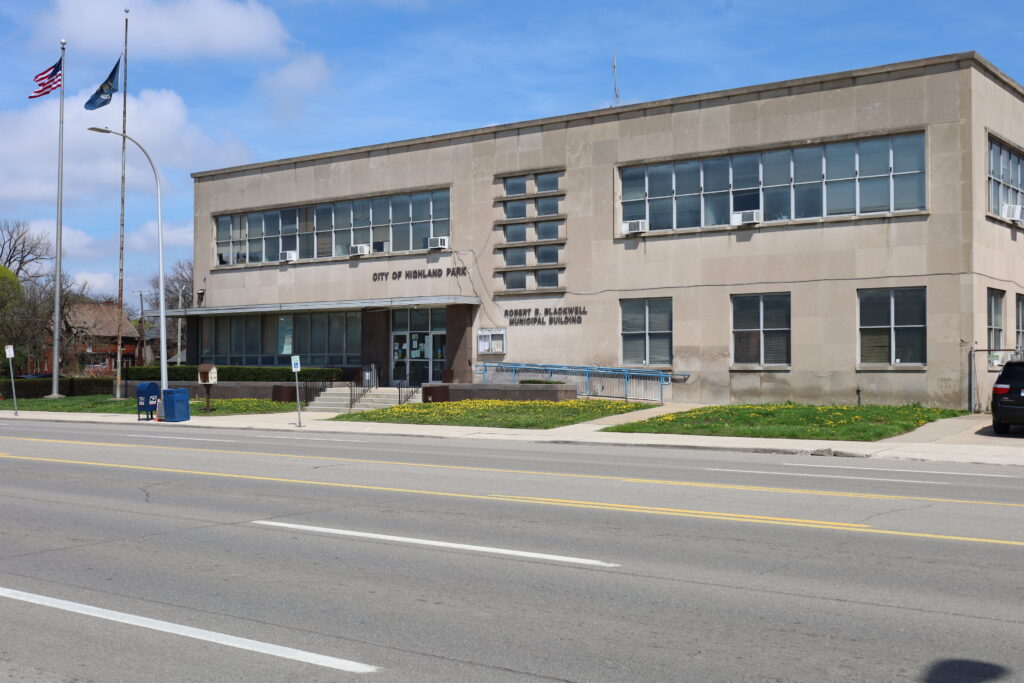
Highland Park City Hall on Woodward.
Highland Park is an odd shape—a trapezoid to be exact. Its borders include West McNichols Road on the north side, railroad tracks along the eastern edge, alleys behind Tennyson and Tuxedo streets to the south, and the Lodge freeway forming part of its western boundary.

These have been Highland Park’s city limits since officials incorporated it 1918.
That’s how it managed to avoid becoming part of Detroit, which had already annexed most of the surrounding land.
Leaders and residents wanted autonomy
Jeff Horner is a professor at Wayne State University‘s Department of Urban Studies and Planning. He says Detroit wanted to absorb Highland Park even before the latter became a city.
“Highland Park was not open to the idea of being absorbed,” Horner says. “They wanted to have some local autonomy.”

Michigan’s Home Rule law in 1909 made it difficult for one city to annex another. That same year, Henry Ford finished building his Model T factory in Highland Park. It was the first Ford plant to use an assembly line. Horner says the city’s population exploded.
“From the 1910 U.S. census to the 1920 census, the population of the city grew by over 1,000% from about 4,500 to about 45,000,” Horner says. “That is remarkable growth.”
Auto industry drove growth
Highland Park kept growing until 1930, peaking at almost 53,000 people. Marsha Battle Philpot grew up in the city and has written about its history. She says Henry Ford’s offer of $5 a day to work on his assembly line drew thousands of people from across the country.
“This was an astronomical sum in those days,” she says. “Maybe an average person might make $5 a month”.
The city’s population steadily declined through the 1930s and 1940s. But it was still relatively prosperous. Philpot says the schools were among Michigan’s best in the 1950s and 1960s.
“Even our elementary schools had swimming pools,” Philpot says. “It was really an extraordinary place to live.”
But good schools were not enough to keep people from leaving the city decade after decade. Ford eventually closed its Highland Park factory, which is now a Michigan historical landmark. Chrysler moved its headquarters, established in 1925, from Highland Park to Auburn Hills. The city’s tax base evaporated. It had so much trouble paying its bills its streetlights were repossessed. State-appointed emergency managers ran the city and the school district for much of the early 2000s, closing the McGregor Library and the high school. Glenda McDonald, Highland Park’s mayor since 2022, says those decisions hit young people especially hard.
“Children need a place to go, and literacy is a very important part of our children’s learning,” the mayor says. “It kind of put a very bad taste in people’s mouths.”
Lansing takes over
McDonald says emergency management didn’t solve Highland Park’s long-term financial problems. One was literally bubbling under the surface: leaky water pipes, some more than 100 years old. The city incurred tens of millions of dollars in debt to the Great Lakes Water Authority. Each side sued the other with the city accusing GLWA of overcharging residents who were too poor to pay for water. The legal dispute pushed Highland Park to the brink of financial ruin.

In 2023, the state intervened again, this time giving the city $100 million to pay its debt and fix its water infrastructure. McDonald says workers are now replacing every lead water line in town.
“We’re working with the state, we’re working with GLWA, and hopefully we’ll continue moving forward that way,” McDonald says.
Had the state not thrown Highland Park that lifeline, the city likely would have filed for bankruptcy. The financial crisis raised a question: would Highland Park be better off becoming part of Detroit? The mayor demurred.
“Blasphemy,” she says.
Legal hurdles, local pride make merging difficult
For one local government to absorb another, state law requires residents of both communities to vote in favor of it after weighing the pros and cons. Stephanie Leiser directs the Center for Local, State, and Urban Policy at the University of Michigan’s Ford School of Public Policy. She says uniting Detroit and Highland Park could reduce bureaucracy.
“You can eliminate some layer of management there,” she says. “They don’t need to have an additional mayor and a clerk and all of those things.”

But Leiser says there’s not a ton of evidence that it would help Highland Park financially.
“They’re not going to save money necessarily on like plowing the roads, picking up trash, or maintaining the infrastructure,” she says.
Leiser says Highland Park’s finances are in better shape than they were when officials were considering bankruptcy in 2023. But it still has challenges, such as high property taxes.
Highland Park has some of Wayne County’s highest millage rates
In 2025, the city’s millage rate for principal residences was 63.221. That’s $63.22 for every $1,000 of a home’s taxable value. The non-homestead rate as over 79 mills. Rates for industrial and commercial personal property were over 57 mills and 67 mills respectively.
Former Highland Park Councilman Ken Bates says the city’s millage rates and pervasive poverty make it hard to attract new investment.
“We have to look into the future as to what will help Highland Park become sustainable,” he says. “What kind of industry should we count on?”

Bates says city leaders need a plan and the expertise to implement it.
“If not, it’s just you maintaining the status quo year after year,” he says. “You’re just one disaster away from financial calamity.”
More than just lines on a map
Bates says Highland Parkers are fiercely loyal to their community and that most want to remain a city within a city. Resident Michael Williams, Sr. admits he wouldn’t rule out becoming part of Detroit.
“We would get more popularity, probably more services,” Williams says.
But other residents, like Kim McDade, don’t see the benefit of giving up Highland Park’s identity.
“Highland Park needs to be given a chance to continue to build,” McDade says. “Our mayor is doing a great job in doing some things and making connections with the right people.”
Mayor Glenda McDonald says the city’s greatest strength is its people.
“They’re resilient, they’re loving, they’re kind, and we take care of each other,” she says. “I know a person on every single street.”
The mayor says that resilience defines Highland Park more than its shape on a map.