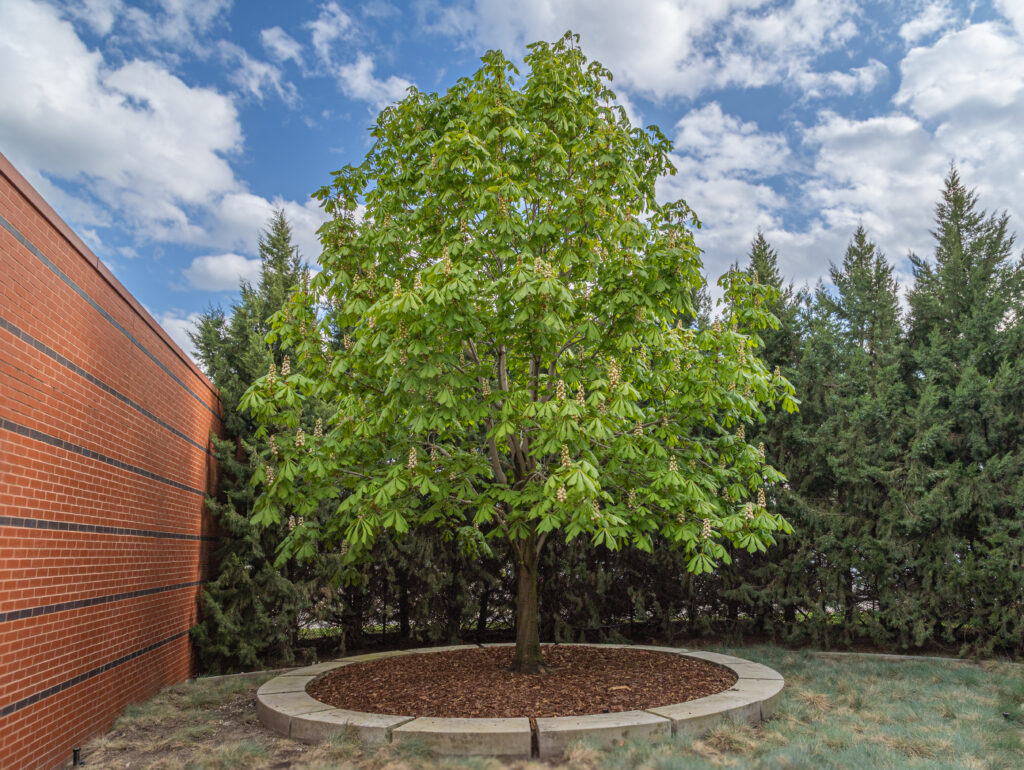
The Zekelman Holocaust Center has a horse chestnut tree grown from a sapling of the tree Anne Frank could see from the annex where her family hid from the Nazis.
The ‘Anne Frank Tree’ is mentioned in the Diary of a Young Girl written by the 12 year old before she was killed in the concentration and extermination camp at Bergen-Belsen.
The Zekelman’s Jamie Miskowski spoke with WDET’s Sascha Raiyn about the tree as a living testament to the story of the Holocaust.
“She wrote about it several times in her diary. About how seeing it gave her hope, a sense of connection to the outside world,” said Miskowski. The tree is an example of spiritual resilience—where someone living through the worst of times still sees something positive in the world.
The original tree outside of the Anne Frank house began to get sick in the early 2000s, and the Zekelman applied to raise one of its saplings to keep its legacy alive. It was one of around a dozen initial recipients.
Having a living artifact poses new challenges with caretaking, but it also resonates strongly with guests and staff as a symbol of Anne and other Holocaust victims’ lasting legacy.
“I also like to think about it as a symbol of the over 4,000 Holocaust survivors who came to Michigan after the war,” said Miskowski, “who themselves put down roots and built new lives, new families, new legacies, careers that outlive them, and found ways to thrive right here in our community.”
The Zekelman Holocaust Center plans to add a multimedia exhibit about the tree to the Anne Frank Gallery in 2027.
– WDET’S Natalie Albrecht contributed to this story.
This story was edited on June 30, 2026 to correct the concentration camp where Anne Frank died and the photo credit.