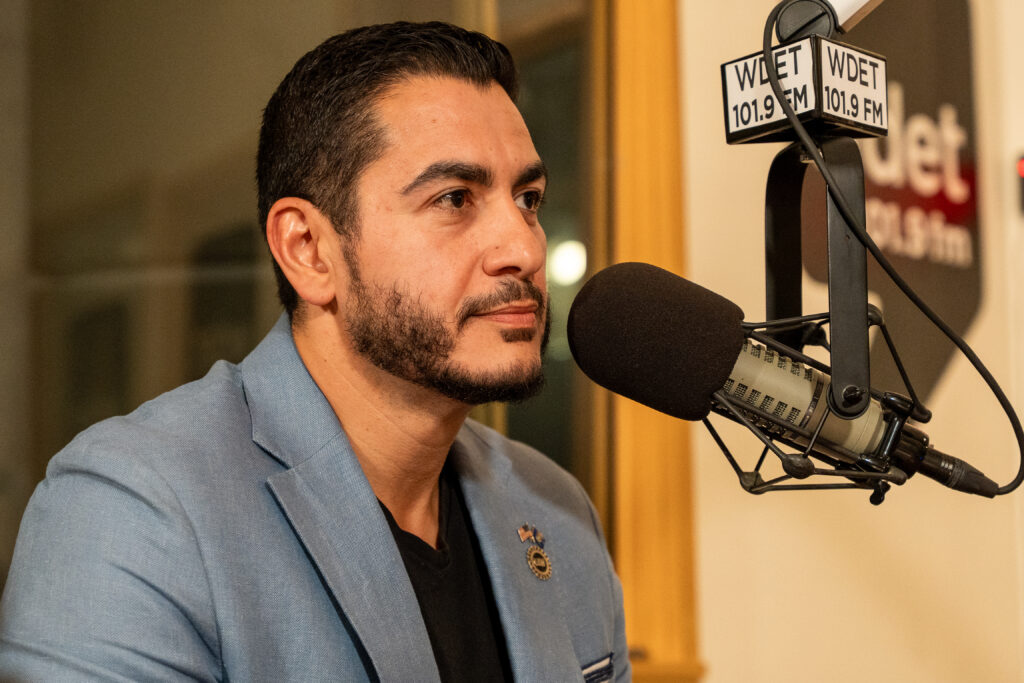
Dr. Abdul El-Sayed says he saw it coming.
“When you launch a campaign and you’re trying to get money out of politics,” he told The Metro, “that invites record amounts of spending against you.”
More than $60 million in outside money went into last week’s Michigan Senate primary, most of it aimed at stopping him. The largest single source was AIPAC, whose super PAC spent about $30 million backing U.S. Rep. Haley Stevens — the most the pro-Israel group has ever put into a congressional primary.
El-Sayed won by fewer than 15,000 votes.
He ran health departments in Detroit and Wayne County, and he now faces Republican Mike Rogers for a seat that could decide control of the Senate. If he wins, he would be the first Muslim to serve there.
He sat down with The Metro’s Robyn Vincent — in the same studio where he announced his run in April of last year.
The money that defined the race
El Sayed came back to the spending repeatedly, including when asked why he lost Detroit. “Ask yourself, if there was no outside spending in this campaign, where do we think votes would have gone?”
He won’t stop saying genocide
Did calling the war in Gaza a genocide drown out his message on health care? He said it isn’t a trade he’ll make: “The job’s not worth it. The work is worth it.”
To Jewish voters who hear his criticism of Israel as criticism of them: “Judaism and the Jewish people are a light unto the world. But Judaism and the Jewish people are different than AIPAC and the Israeli government.”
Black Democrats and the ‘uncommitted’ vote
Many Black Democrats in Michigan blame the 2024 “uncommitted” protest vote, which El-Sayed backed, for costing Kamala Harris the state. Keith Williams, who chairs the state party’s Black Caucus, endorsed Stevens and said El-Sayed was with uncommitted only when it suited him.
“Convenience would have been to say nothing and stay quiet,” El-Sayed said. He noted that Harris endorsed him Friday. “I don’t think she thinks I’m the reason that she lost.”
On mistrust between Black and Arab Detroit, he said Arab and Muslim Michiganders can’t object to anti-Arab racism while tolerating racism toward Black Detroiters. “Standing up against racism is about principle. It’s not about tribalism.”
Data centers and health care
El-Sayed said what he’d write into federal law on data centers, after campaigning against the Oracle and OpenAI project in Saline Township: protections for local water, no utility rate increases, guaranteed union jobs, and money held in escrow before construction begins.
On Medicare for All, he acknowledged a freshman senator can’t deliver it alone. “You can’t get it all in one shot. But politics, as all of us know, doesn’t just move linearly.”
The Metro has invited Republican candidate Mike Rogers on the program several times and has not heard back.
Hear the full conversation using the media player above.
Listen to The Metro weekdays from 10 a.m. to noon ET on 101.9 FM and streaming on-demand. Never miss an episode — subscribe to The Metro on Apple Podcasts, Spotify, YouTube, or NPR, or wherever you get your podcasts. Have thoughts? Email the show at metro@wdet.org.