
The Metro: What the archives of bureaucracy can tell us about colonial administration in the U.S. today
David Leins The Metro November 13, 2025Evidence of colonization in the United States is stored in filing cabinets and archives of bureaucracy, and is still evident in the U.S. government today. Maggie Blackhawk, a scholar of colonialism, imperialism, and American Indian history joined The Metro to discuss.
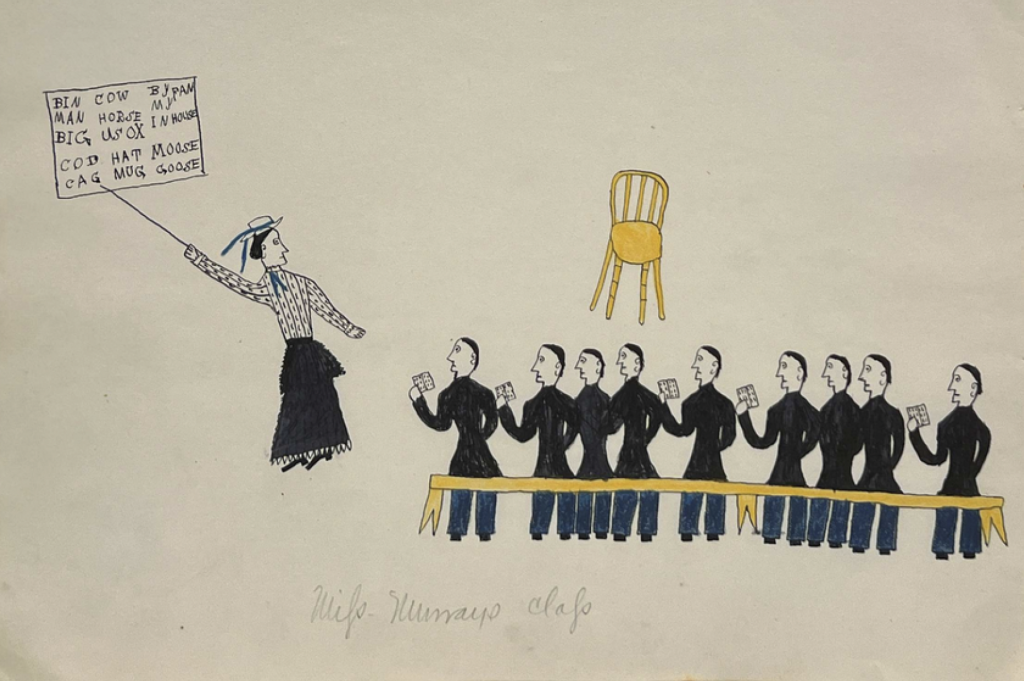
"Miss Murray's Class 1876" by Nockkoist (Bear's Heart) of the Northern Cheyenne Indian Nation.

Evidence of colonization is embedded in the United States government. Through the Bureau of Indian Affairs, or the U.S. territories that are governed by colonial administration models, like Puerto Rico and the U.S. Virgin Islands.
The place we now call Detroit, or, Waawiyatanong, the ancestral and contemporary homeland of the Three Fires Confederacy, has a unique place in United States’ colonial history.
The people of the Three Fires Confederacy—the Ojibway, Ottawa and Potawatomi nations, or collectively Anishinaabe people, were subjects of colonialism, violence and displacement. First by European settlers, then by the United States government. That process was carried out and documented by bureaucratic process, what scholars call colonial administration.
Maggie Blackhawk is the Moses H. Grossman professor of law at the NYU law school. She’s an expert in colonial administration, law, and history.
She spoke to Metro producer David Leins about what we can learn today from the bureaucratic records of the past to better understand colonialism in the U.S. and Michigan.
Subscribe to The Metro on Apple Podcasts, Spotify, NPR.org or wherever you get your podcasts.
Listen to The Metro weekdays from 10 a.m. to noon ET on 101.9 FM and streaming on demand.
Trusted, accurate, up-to-date.
WDET strives to make our journalism accessible to everyone. As a public media institution, we maintain our journalistic integrity through independent support from readers like you. If you value WDET as your source of news, music and conversation, please make a gift today.Donate today »
More stories from The Metro
Authors
-
David Leins is the senior producer of WDET’s daily news and culture program, The Metro. He has produced several award-winning podcasts and multimedia series at WDET including Tracked and Traced, Science of Grief and COVID Diaries, which earned a National Edward R. Murrow Award for Excellence in Innovation. He previously led WDET’s StoryMakers program. David has an M.A. in Media Arts and Studies from Wayne State University, and a B.A. in anthropology from Grand Valley State University with a minor in Arabic. David teaches podcasting at Wayne State University and is an alumnus of the Transom Audio Storytelling Workshop.