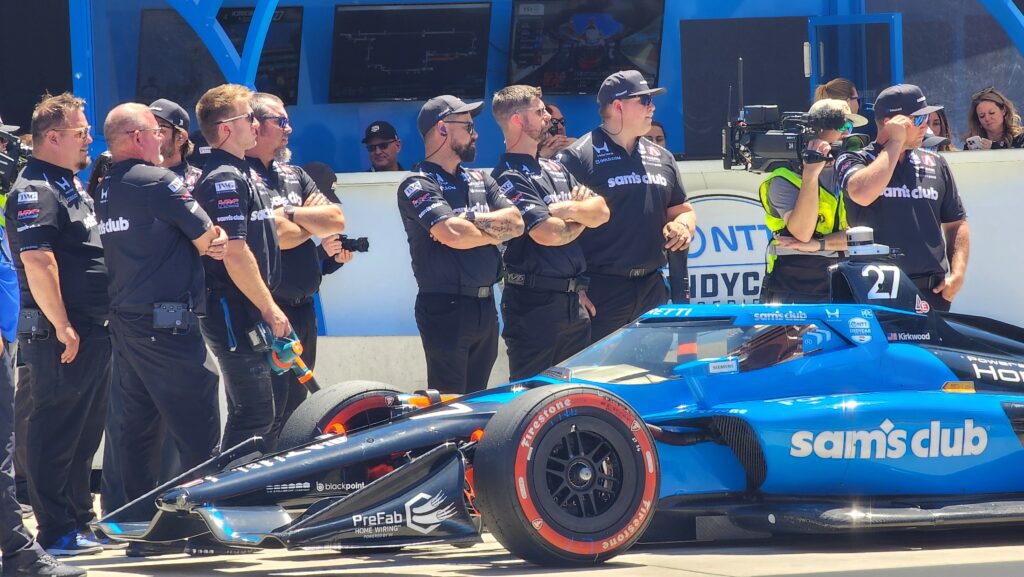
After practice comes qualifying, to decide the starting order for race day. Kirkwood says it can be hard to set a clean lap time in Detroit. Traffic is common on the narrow track.
“It’ll create some excitement for sure,” he says. “I don’t like the excitement if I’m being honest, because I think we just have really fast cars. But, same time, if we have a fast car we should be able to do the right thing.”
And he was fast in qualifying. The No. 27 Honda advanced through each round with a chance to start the Detroit Grand Prix on pole.
However, Bryan Herta says an error by Kirkwood on his final qualifying lap cost them a chance to roll off first on Sunday.
“We’ve had a really fast car,” says Herta. “I think we’re a little disappointed with qualifying in sixth.”
Despite that, Herta doesn’t expect the mistake to stick to his driver.
“The thing I’ll say is I really enjoy working with Kyle,” Herta explains. “He doesn’t get too up when things are going well and he doesn’t get down when we’re working through struggles… and he’s fast. He can deliver. He does what we need him to do in races.”
And what Herta needs Kyle Kirkwood to do is not always drive like it’s the last lap of the Detroit Grand Prix.
Strategy
Racing is about more than just raw speed. If you drive the car as hard as it can possibly be driven, you will use more fuel and wear the tires out quicker, slowing you down in the long run.
In IndyCar, there are two different kinds of tire — one that is slower but lasts longer, and one that is fast but has a shorter lifespan.
Teams must run both types of rubber during the race. Herta says that adds an element of strategy crews need to figure out.
“So it’s really just the order in which you want to run your tires that’s going to be the differentiator.”
Race day
On race day, Herta and Kirkwood played their strategy correctly. A well-timed pitstop early in the running allowed the Andretti team to move its way forward and into a fight for the race win.
When the checkered flag flew after 100 laps, Kyle Kirkwood crossed the finish line in second position. He says the result made for a good day.
“You can’t be very upset with starting sixth and finishing second.” — Kyle Kirkwood, IndyCar driver
“You can’t be very upset with starting sixth and finishing second,” says Kirkwood. “We did all the right things. Pit stops were great, strategy was great.”
The result moves the No. 27 Honda up into second place in the season-long championship standings. Unfortunately for the Andretti Global team, it the man leading the title fight, Alex Palou, won the race.
Never-the-less, Kyle Kirkwood says he has his eye set on winning his first title.
“I still think that we can catch up,” says Kirkwood, “It’s not done and lost by any means.”
Kirkwood and Herta still have time to make that happen. As the IndyCar series leaves the Motor City, there are 10 races left to decide this year’s champion.
Trusted, accurate, up-to-date.
WDET strives to make our journalism accessible to everyone. As a public media institution, we maintain our journalistic integrity through independent support from readers like you. If you value WDET as your source of news, music and conversation, please make a gift today.
Donate today »