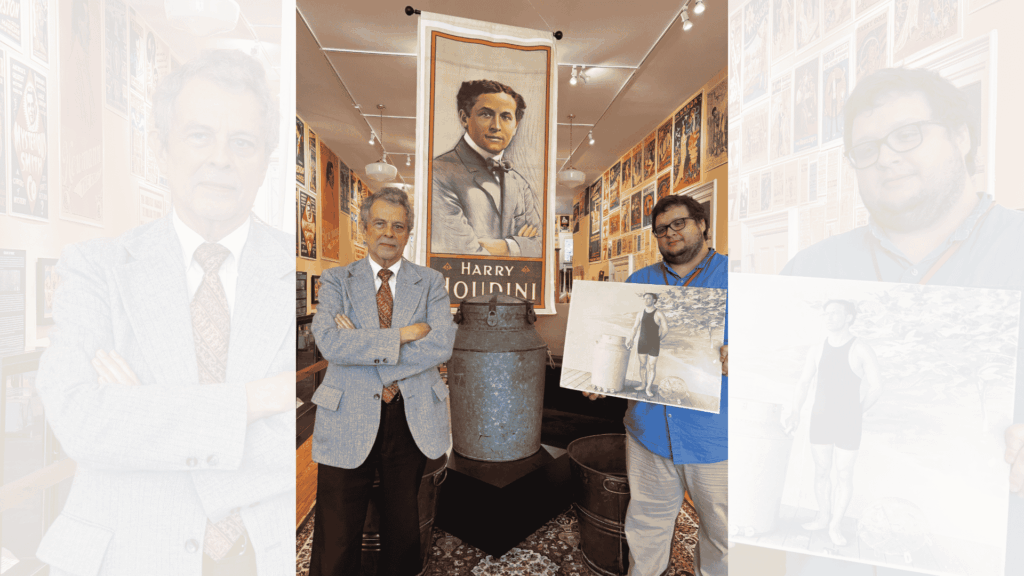
This Halloween marks the 100th anniversary of the death of the legendary magician Harry Houdini.
He earned his reputation by freeing himself from traps it often seemed no mere mortal could survive.
But Houdini couldn’t escape the ultimate fate waiting for him in Detroit.
And his spirit still haunts the Motor City.
A life defying death
Harry Houdini performed in Detroit 19 times between the early days of his career in 1894 to the final show of his life in 1926.
The trajectory took him from being a bottom-of-the-bill act to one of the most famous entertainers in the world.
He escaped obscurity by declaring no set of handcuffs or jail cell could hold him.
He dangled upside down from office buildings wearing a straitjacket, dramatically removing them in full view of those raptly watching below.
Sometimes the buildings housed the local newspaper, ensuring free publicity for Houdini’s upcoming stage shows.
There was always a dash of suspense involved that Houdini encouraged and sometimes inflated.
In Detroit, Houdini jumped two dozen feet from the Belle Isle bridge into the frigid river below, bound with two sets of police handcuffs.
He emerged unscathed, but the legend around it grew.
The escape artist had leaped into a hole in ice covering the river, the story went, finding air pockets to breathe in before finally surfacing.
Reports from the time show the river was not actually frozen.
But that didn’t stop movies decades later from portraying it that way.
He even scared his assistants
As his fame grew, and a series of other magicians began copying his escapes, Houdini ramped up the stakes, stacking one increasingly death-defying feat on top of another.
By 1914 he had unveiled his signature stunt, the Water Torture Cell.
It was a coffin-sized box, filled with water.
Houdini was lowered into it head first, both his ankles and the top of the box locked.
A curtain was raised to hide the magician’s moves to escape from the audience.
And even those behind the scenes, who’d seen the act many times, had goosebumps.
That included Dorothy Young, who toured with Houdini as a stage assistant when she was 17 years old.
“Mrs. H always stood in the wings because they had a secret code in case he couldn’t get out,” Young said. “I always watched because it was very exciting!”
Houdini’s final show
Young was the last surviving person to have worked with Houdini before she, too, died in 2011.
A few years before, Young recalled how many movies exaggerated the circumstances of Houdini’s demise.
He did not dramatically struggle to escape the torture cell.
Houdini had actually been dealing with a broken ankle in the days before he traveled to Detroit.
In his dressing room at a show in Montreal, Canada, a college wrestler took up the magician’s challenge that he could withstand any blow to his stomach.
But the student punched Houdini several times before he could tighten his muscular midsection.
“One time he showed me that he had a way of doing it,” Young said. “And to think those boys didn’t give him a chance to get himself protected.”
Houdini was in severe pain and doctors advised him to rest.
But he refused to cancel a series of shows already scheduled in Detroit.
One of the curators at the Detroit Historical Museum, Jeremy Dimick, notes that Houdini was under financial pressure to fulfill his contract.
Dimick said Houdini only made it through one performance.
“He doesn’t have the strength to put his makeup on before the show and he’s kind of collapsing during the intermissions of the show. And then he has to be literally carried from the Garrick Theater back to his hotel,” Dimick said.
Houdini was taken to Grace Hospital, where doctors found he’d ruptured his appendix.
Several days and two surgeries later, on Halloween, Houdini breathed his last.
Houdini’s Detroit haunts have vanished
Now the theater, the hotel, even the hospital are gone.
The Detroit funeral home that embalmed him became a girls’ art school.
It’s fenced off from the public now.
But two decades ago, the head of the school then, Juanita Hammond, would still take visitors up a creaky set of stairs to a locked storage area with an indented floor where bodily fluids once drained.
“This is the room, where it says ‘Private.’ Houdini was laid out here by the Hamilton Funeral Home in this room here,” Hammond said.
It was a school Hammond said made students at the time a bit apprehensive
“Some say I’m not going back to the kitchen because I might see Houdini. Ha!”
Searching for his spirit
The escape artist’s wife, Bess Houdini, spent years trying to see her husband again, or feel his presence.
She held séance after séance searching for his ghost, though the magician himself had spent his final years exposing psychics he said preyed on the bereaved.
But at a séance on Halloween a decade after her husband’s death, Bess Houdini finally said good night to Harry.
She reenacted the scene in a movie a few years later, appearing in a cameo as herself.
“And you remember what he always said about these things? That it was impossible for the dead to return,” she said. “This proves he was right. For if it would have been possible, I would have had some sign from him in the past ten years.”
Still trying to make contact
That did not stop others from trying to reach the Great Houdini in the great beyond, sometimes incorporating old pieces of his stage act.
At the American Museum of Magic in Marshall, Michigan, about 100 miles west of Detroit, John Sherwood bangs on an empty, aged metal can from Houdini’s workshop.
It became the centerpiece of several séances.
”That is the Houdini milk can. Houdini would jump into this while it was filled with warm water and he would be locked inside with six Mastodon locks,” Sherwood said.
Like the torture cell, a screen surrounded the milk can while Houdini was staging his escape.
He would invite the audience to try and hold their breath while he was doing it.
After many minutes, with no sign of Houdini, the crowd would scream for them to let him out.
No one could survive submerged that long.
In reality, Houdini had escaped long before and would be reading a newspaper promoting his next show while the tension built.
Finally, with the crowd’s anxiety at a fever pitch, Houdini’s assistants would splash him with water, since he had dried of by then, and the Master of Suspense would emerge from behind the screen, theatrically panting.
The audience would erupt in cheers.
Will Houdini return for a bite to eat?
Decades later, Sherwood said those holding séances he participated in would circle around the milk can and other Houdini artifacts as they tried to contact him.
Sherwood said they used a special trick to coax the magician back to the land of the living.
“Wanted to lure him in by essentially appealing to Houdini’s Jewish heritage by placing a lox and bagel sandwich into the milk can and invited Houdini’s spirit to take a bite out of it.”
Now Sherwood is orchestrating another séance.
Though previous attempts were not successful, Sherwood said the centennial of Houdini’s death might be the perfect time for the magician to appear, if for no other reason than Houdini’s sense of showmanship.
“I’ve always said that the greatest publicity stunt that Harry Houdini ever pulled off was dying on Halloween. Because after that the mythology about him grew by leaps and bounds.”
It’s also conjured conspiracy theories.
Was Houdini’s death certificate altered to purposely make it appear he died on Halloween?
Was the wrestler who punched him a hitman sent by angry psychics to assassinate the escape artist?
In some ways Houdini’s death mirrors the stunts he performed in life — shrouded in mystery.