Highland Park is a small city that once had a relatively large population for its size. At the height of Detroit’s automotive boom, more than 50,000 people lived within Highland Park’s 2.9 square miles. Today, the population is less than 9,000.
WDET’s Crossing the Lines series features conversations with and stories about Highland Park’s people, culture, and history.
Detroit Public Radio’s Citizen Vox project gives residents a chance to express how they feel about their communities and the issues that matter to them.
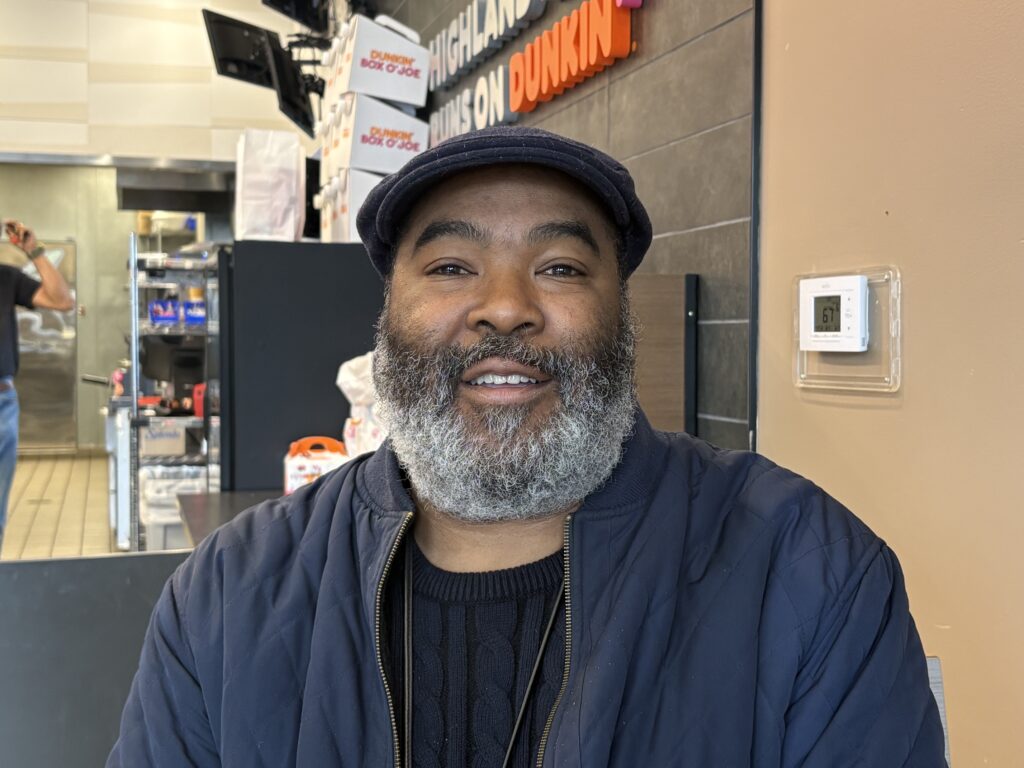
WDET’s Pat Batcheller spoke with Highland Park resident Ken Bates at a coffee shop on Woodward Ave. on April 10, 2026.
Bates was born in Detroit but moved to Highland Park with his wife more than 25 years ago. They bought a Craftsman-style bungalow in a historic district of the city. Voters elected Bates to the city council in 2018, where he served until 2022. He chairs the board of an energy nonprofit called Soulardarity. Its mission includes installing solar-powered streetlights in Highland Park’s neighborhoods.
Bates shares his thoughts on housing, poverty, community pride, and development.
Ken Bates: We know that there’s a housing crisis, a housing shortage nationally, affordable housing. Highland Park has an abundance of land that is underutilized, that really could be put forth in terms of development. So, we could look at land trusts. We could look at affordable housing, low-income housing, market rate housing, duplexes to grow the population because that’s what we have in abundance.
Manufacturing? I doubt that will ever come back to the extent that Henry Ford and Chrysler and some of the other manufacturers had here. That’s a bygone era.
And so, we have to look into the future as to what will help Highland Park become sustainable. What kind of industries should we count on?
You have to get education on board. You have to get private development. You have to get your government funding all in order, and you have to have a plan and a vision and the expertise in order to do it.
If not, you’re just maintaining the status quo. And year after year, you’re just one disaster away from some financial calamity, whether it be a natural disaster or something like the Great Lakes Water Authority suing us for $19 million and threatening to put it on our tax rolls.
Pat Batcheller: What do you like about being in Highland Park?
KB: Highland Park is centrally located. It’s convenient. There’s a sense of—like with my block, I never expected it to be so diverse. And yet you’ve got immigrants, you’ve got people of different faiths. You’ve got people who are ascribed to different lifestyles. I mean, it just it goes on and on, different political beliefs, and we all live together in the same community, and we’re able to communicate and talk and look out after each other.”
PB: From the conversations I’ve had with you and some of the other folks I’ve talked to, it isn’t really the borders that define Highland Park, it’s the people. Would you agree with that?
KB: Well, yeah, I would say the people do define Highland Park because, because again, they’ve been here. Most have been here quite a long time. And even if you travel outside of Highland Park and talk to people that formerly lived here, many people will tell you, ‘Yeah, my grandparents lived here.’ They remember it as a great city. They’ve had fond memories.
The historical district is obviously something that has gained attention. People are looking at those homes and, if they have the means to renovate them, are coming in and deciding, “well, let’s renovate this home.” Because you can’t rebuild those anywhere for anything that I would consider reasonable.
Highland Park has just had its own identity for a long, long time. And so, I can’t see that changing because it would be so difficult to incorporate us into the Detroit culture. We’re not Detroit. We’re not Hamtramck. We’re Highland Park.
PB: What’s the most pressing issue facing Highland Park right now?
KB: It’s poverty. You’ve got to figure out how to raise people’s incomes up, so to speak, their standard of living. So, whether it be through employment, homeownership, because poverty impacts everything around us. For example, ALDI is usually out of shopping carts because people abscond with them. If you’re running a business, that’s not helpful. We were fortunate in that Foot Locker moved into the old CVS building because CVS, Rite-Aid, and another drugstore left.
Convincing businesses to come here is a real challenge because the landscape has changed. Brick and mortar stores aren’t necessarily how people are going about retail experiences. You would think that we would have a thrift shop or something of that nature in a community like that. We don’t.
So, trying to look at trends that will allow people to be gainfully employed, increase home ownership, educate their children are things that should be made priority.
The appearance of the city has to change because we have a lot of blight. We had a press conference celebrating the announcement of Highland Towers on Woodward being torn down. We’ve got to have news that is uplifting, that is showing progress now. Yes, the building should be torn down because it’s caught on fire sixteen years ago. But we need to be announcing opportunities for growth projects that will bring about change.