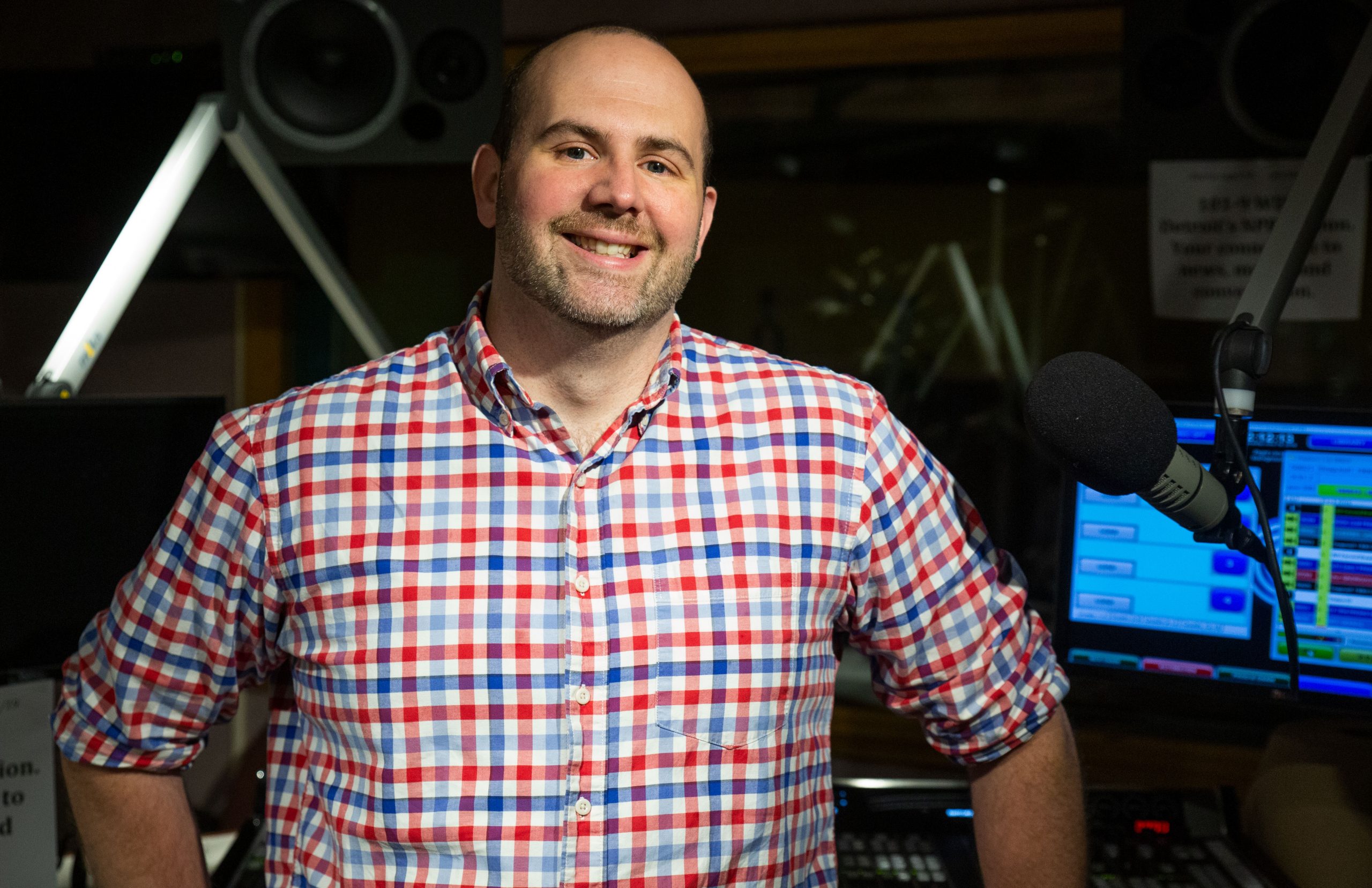
University of Michigan Professor Derek Peterson wanted to highlight the work of school activists – both past and present – in his commencement speech over the weekend.
What he got was controversy.
Peterson discussed the work of suffragette Sarah Burger Stearns, the woman who worked for years to get the University of Michigan to admit women to the school. He talked about the Black Action Movement of the 1970s and ’80s that sought to make campus life better for people of color. Peterson championed Moritz Levi, the first Jewish professor at U of M.
However, it was a short clip of Peterson praising the work of campus pro-Palestinian protesters that drew the ire of conservatives, pro-Israel activists, and school leadership.
Elyssa Schmier of the Michigan Anti-Defamation League called it “inappropriate, divisive, and deeply unfair” to Jewish students.
Interim U of M President Domenico Grasso apologized for the speech, calling it “hurtful and insensitive.”
In response, the University removed the YouTube video of the entire commencement.
For his part, Peterson is unfazed.
He’s a tenured history and African studies professor and has been with the university since 2009. He’s a former MacArthur “genius grant” recipient and the outgoing chair of the Faculty Senate.
He tells WDET’s Russ McNamara that he’s surprised by the controversy – especially after his remarks were approved by the U of M leadership.
Derek Peterson: I thought I was giving a speech that was meant to congratulate all these students on the success of their time at Michigan. And I wanted to honor student activists. We had these two consequential athletes on the rostrum sitting beside me, Michael Phelps and Jalen Rose, both of whom I greatly admire. And I wanted to give equal time to student activists who I think have done more than most to push our university along the path toward social justice. So the goal of the address was not to provoke or cause controversy. It was to expand the kinds of things that we honored at our commencement ceremony and to bring into view how much I myself have learned and benefited from the work that generations of activists have done here in Ann Arbor.
Russ McNamara: It seems like – recently – there’s been a measure of work done by some to minimize activism at the University of Michigan.
DP: Faculty Senate leaders don’t often get an audience with the regents and with opinion leaders across the state as much as one does at commencement. And we’ve been trying for the past year, and past two years, in fact, to make an argument about how Michigan’s acquiescence to federal authorities around student protests has damaged our collective culture.
The space for protest on campus this past couple years has been dramatically constrained. The administration has instrumentalized the Student Conduct Code and made it much more difficult to organize protests.
Meanwhile, federal authorities have gone after international students and made the cost of protesting, regardless of what kind of person you are, much higher, specifically, if you speak on behalf of Palestinians.
So I’m a tenured professor. I’ve got all these titles after my name, and I felt it was a good occasion to honor the work that activists have done, and to bring it into view in a place in which it was increasingly difficult to see how much activists have contributed to our collective life.
RM: Is it surprising to you that when someone like Regent Sarah Hubbard says commencement is not the time or place for political messages? Because I read that and I’m kind of surprised that someone who graduated from the University of Michigan would not feel that at any point, there couldn’t be a political message attached to the university or in that city.
DP: Yeah, I don’t know if she’s ever really spent time with Michigan students. The idea that graduation ceremonies should be apolitical, nostalgic, that sort of thing, is just bunk.
The University of Michigan is not a finishing school for polite men and women, and our students are not freaking wilting flowers. They’ve just finished their degrees at the foremost public university in the United States. They can freaking well-handle controversy. They don’t need to have sentiment and nostalgia slathered upon them.
What they need is a spine stiffening. They need encouragement to face injustice and inequity with the tools that we’ve given them here at the U of M. It’s take what you’ve learned at this public institution and go and serve the public to which we are beholden as the world’s leading public university. So I fundamentally disagree with the idea that graduations should be, you know, romantic and uncontroversial. That’s a betrayal of the purposes of public education.
RM: You wrote a book that came out last year, A Popular History of Idi Amin’s Uganda. In this moment, are there lessons that can be learned about the United States, about world politics from Idi Amin’s Uganda?
DP: The book, which I wrote over the course of something like 20 years, is grounded on a lot of research that I did with archives that had been deliberately suppressed or lost or forgotten over the course of generations after Amin fell from power in 1979.
As a scholar, much of my work is about how through industrious historical research, we can uncover lessons and materials and ideas that have been either forgotten or suppressed by people in power. So as a scholar of African history looking at events in 2026 in Ann Arbor and around the United States, where it’s increasingly difficult to say anything at all about what happened in Gaza, I can’t play along with that deliberate silencing of an act of great violence.
And let me say I’m full of sympathy for Jewish people who suffered, including students at U of M who suffered as a result of the awful actions of Hamas on the seventh of October 2023.
I don’t have any sympathy for Hamas sympathizers, but as the leader of the Faculty Senate and as a faculty member who studies colonial and post-colonial African history it’s really important that we don’t invisibilize Palestinian suffering, particularly in a state in which many of our students come from the Middle East and have relations who have died in the course of Israel’s war in Gaza.
So honoring their experience at commencement seemed to me to be as vital as it was, also as I did to honor the experience of Jewish students who have found a safe haven in Ann Arbor over the course of generations.
I’m troubled by the fact that this speech has been portrayed as being antisemitic. It’s not. It was not. And I don’t feel the need to apologize for the speech, as I’ve been asked to do by people in administration here at U of M.
I do regret that Jewish attendees might have found themselves on the back foot, troubled by the remarks. I didn’t have the purpose going into it of provoking unhappiness on a happy day. And if I did it over again, I probably would add a sentence to the end of my speech. I would have phrased it something like ‘sing for Jewish students at the university who, over the past two years, have kept the memory of their loved ones who died on the seventh of October alive and have brought their suffering into view here at the university as well.’
I can honor the violence and trauma and be appalled by the awfulness of the seventh of October 2023 and also be vigorously pro-Palestinian and appalled also at the violence of Israel’s war in Gaza. I think both things are possible.