
The fight to save Michigan’s hemlock trees is far from over
Michigan officials recently warned property owners to watch out for a devastating invasive insect infestation on hemlock trees.
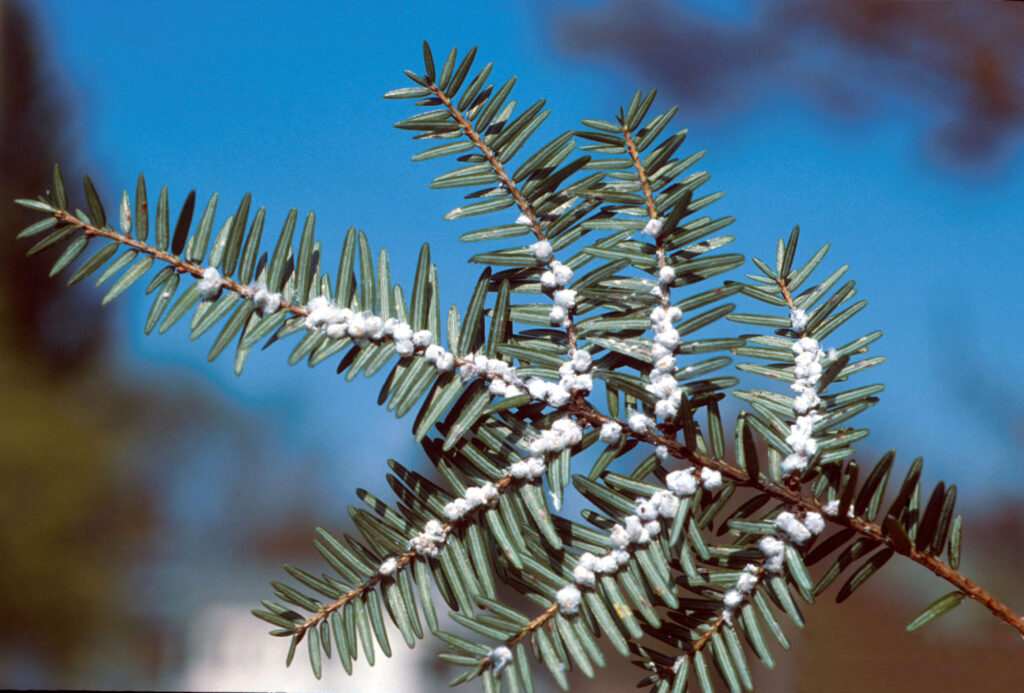
Hemlock woolly adelgid infestation on a hemlock branch.
Michigan’s Department of Agriculture and Rural Development says the spread of hemlock woolly adelgid along Lake Michigan is increasing. Native to East Asia, hemlock woolly adelgid is an invasive insect that attacks Hemlock trees, feeding on their sap and killing them between 4 and 10 years of infestation.
According to the MDARD, it’s been detected in Allegan, Antrim, Benzie, Leelanau, Manistee, Mason, Muskegon, Oceana, Ottawa, Van Buren, and Washtenaw counties.

Rob Miller is the Michigan’s Department of Agriculture and Rural Development’s (MDARD) invasive species prevention and response specialist. Miller has played a crucial role in slowing the insect’s spread across the state.
“Hemlock woolly adelgid really became a problem… between 2015 and 2017. It was [unintentionally] brought into the state on nursery stock that was infested with hemlock woolly adelgid [and] there are no native predators or diseases to keep [their] populations in check,” Miller says.
While infestations have been found at the University of Michigan’s Nichols Arboretum, Miller is not overly concerned for Southeast Michigan. He says Southeast Michigan’s climate isn’t suited for hemlock trees, so the area doesn’t have a large population of them to worry about.
However, Miller is very concerned for the infestations detected in the west and northern regions of Michigan’s Lower Peninsula, where there are hundreds of hemlock trees.
Treatment for hemlock woolly adelgid
Unfortunately, Miller says the infestation is too far along and too widespread for eradication to be an option for MDARD. One way the state is supporting this effort is by funding local conservation districts that have Cooperative, Invasive Species Management Area (CISMA) programs. Miller says this partnership gives local conservation districts more resources to directly treat and prevent hemlock woolly adelgid infestations.
For property owners, there are two different insecticides to treat hemlock woolly adelgid infestations: imidacloprid and dinotefuran.
Miller differentiates these chemicals by the speed they move through trees; imidacloprid moves slowly and protects the tree for longer, and dinotefuran moves quicker and protects the tree for a couple of years.
Both insecticides are neonioctinoids, which are harmful among pollinators. However, Miller explains that application techniques reduces the environmental risk of these chemicals.
“You’re applying [insecticide to protect hemlock trees] either directly to the trunk of the tree or you’re actually injecting it in the tree. You’re not spraying it all over the place…shooting it out of a high pressure hose [or] using a mist system,” he says.”
“So, when it’s applied to the tree properly, it’s very targeted and that chemical is then actually inside the tree, and we don’t have any runoff.”
This story is part of WDET’s ongoing series, The Detroit Tree Canopy Project.