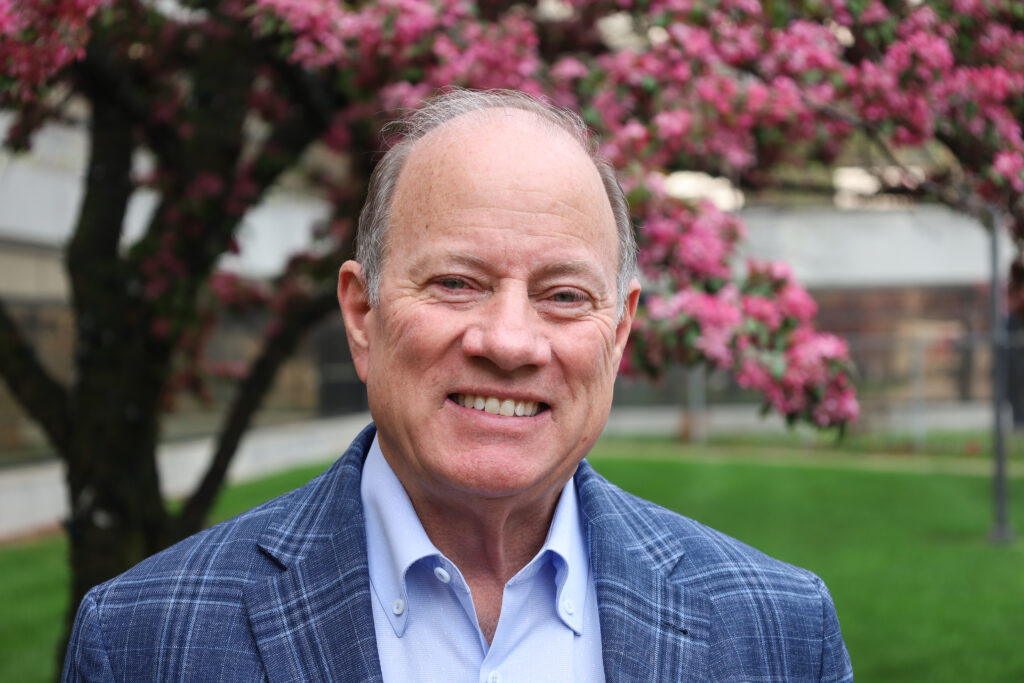
There’s an unusual twist in this year’s race to become Michigan’s next governor.
Longtime Democrat and former Detroit mayor Mike Duggan is running for the state’s top job as an independent.
Duggan says taking the long view of what Detroit needs in the future helped turn his eyes to Lansing.
Editor’s note: This interview has been edited for length and clarity.
Mike Duggan: I was born in Detroit and the city I grew up in was spectacular. You could get a good-paying job in the auto plants, the neighborhoods were beautiful, the shopping was great. And in the course of my life, everything that we knew was taken away from us. The auto plants moved out, the stores moved out, the banks moved out, the movie theaters moved out. I ran for mayor because I felt like the federal government, the state government and other people had turned their back on Detroit for too many years. And I felt like if we pulled together, we could change the trajectory. And you saw what happened, with all of the factories that came back, the rebuilding of the riverfront, the violence going way down. When the population numbers came in last year and we grew by 7,000 people and led the state of Michigan in population growth, I felt like I’d done what I had set out to do. So really the next question was, do I go back to the private sector or do I try something else in the public sector?
Quinn, you know the biggest problem in Detroit is the public school system. And when we had 7,000 people move back, we weren’t having families with school-aged children. And I think (Superintendent) Dr. Vitti and the school board are doing a good job with the resources they’ve got. But the state has not supported public education. And 60% of all the children in Michigan, not just Detroit, do not read at third grade level. You’re stealing the futures of these children by the time they’re nine and 10 years old if they can’t read. That’s certainly critical.
There is nowhere you go in the state where people are not stressed by the cost of housing. Young people are being forced out of the state because they can’t afford their first home, whether it’s an apartment or a house. There’s no easy way to say this, but the jobs of the future are going to Ohio and Indiana. Our biggest export is no longer our cars, it’s our young people. People said you can’t solve the affordable housing problem. In Detroit, we built 6,000 units. And I understand how we did it. We didn’t do it with a lot of state help. But if you both reduce the cost and put in some subsidy, the problem is solvable, as we’ve proven.
Quinn Klinefelter: When you do go around the state, is what you’ve done in Detroit translating to people outside the metro area? Do they say, “What’s some Detroit guy doing, coming in here trying to tell us what to do?”
MD: It’s so interesting. I’m spending a lot of time on farms. I’ll have 25 farmers who’ll say, “What does the mayor of Detroit know about us? We’ve been ignored. We’ve been forgotten. Our costs for our fertilizer is going up. We don’t have access to markets. Nobody in Lansing cares about us. What does the mayor of Detroit know about us?” I said, “Gee, let me see. What does the mayor of Detroit know about representing people who feel like they’ve been ignored and forgotten? I’d like to take you back to Detroit and introduce you to a mom who is raising two kids on a block with four abandoned houses, no streetlights, parks completely overgrown with grass. The ambulances and police didn’t show up. I didn’t make excuses. We went to work and solved the problem. Let’s talk about your problem.”
And you should see their shoulders actually relax. They think, “Maybe we have a lot more in common with Detroit than we ever thought.” I’m talking to farmers who can’t get permits from EGLE to build a new irrigation system because they don’t have inspectors. And I tell them about the housing projects that got delayed because EGLE couldn’t get inspectors to it. Before long, it turns out there’s a lot more in common in this state than we think.
QK: I know it’s all politics, but you were really a standard bearer for the Democrats for a long time. Now you’re running as an independent. You’re technically the political enemy. They’re running billboards that you’re spreading contaminated dirt all over the city. What’s it been like for you facing that after being for so long a face of that party?
MD: You said it right. They treat me like I’m the enemy. And I think that’s why people are so angry at the two parties. You look at the polling nationally and Gallup says this year 27% of Americans consider themselves a Democrat, an all-time low. And 27% Republican, an all-time low. And 45% independent, an all-time high. It’s because the two parties don’t tell you what they’re going to do, they’re just so toxic tearing each other down. And the Democrats have done me enormous good. Because as soon as I announced I was an independent, they didn’t say he has a bad record on crime or housing or jobs. They say he’s corrupt, he’s MAGA, he’s poison dirt, he’s whatever. It’s all this same stuff. And I’m just saying to people if you think the two parties are working for you, you’re gonna have a Republican and Democratic candidate. But if you think this state is heading in the wrong direction, I’m gonna give you a third choice.
QK: The political pundits will always say that an independent doesn’t have any chance, you’re just gonna waste your vote if you go for them. What’s your response to those kinds of comments?
MD: Yeah, those were the same political pundits that said in 2013 a white guy can’t get elected mayor in an 83% black city. You know how many times I heard that? But it’s different when you sit down with people and talk to them about their situations and how we solve them. I’m doing seven, eight town halls a week all over the state, just the same way I campaigned for mayor. And the people who are showing up, we’re not doing stuff where you rail on Trump, you rail on Whitmer, you talk about the evil folks on the other side. These folks want to talk about what’s going on with the data centers and why aren’t we being protected so that we know if they’re coming here that our rates won’t go up and that our water won’t be damaged. We’re talking through solutions. And it’s Republicans and Democrats sitting in rooms together.
Quinn, this is the most fun thing. We’re in a primary time where the Republicans are going to the Republican clubs. They’re going to the Muskegon Republican club or the Grand Rapids Republican club. The Democrats are going to the Democratic clubs, they’re at the Westland Democratic club or the Alpena Democratic club. I don’t have any clubs. So I’m having open town halls in community centers and restaurants and churches across the state where Republicans and Democrats both come and listen. And they invariably take my petition forms, head out the door and say, “I want to have a third choice.”
This is the thing I found out. No matter where you go in the state, people are fed up with the two parties. It was pretty interesting, last August 200 elected officials endorsed me at a big event at the Michigan Central train station, about 100 Democrats and 100 Republicans. And the Democratic Party chair, Curtis Hertel, was so angry he announced he was punishing the hundred Democrats who stood up with me, shutting off their access to voter lists. You have advantages and disadvantages, but I’m not spending time whining about it. I’m gonna go get far more than the number of signatures needed to get on the ballot. I have to put in 30,000 signatures by July 15th. We’re doing well, we’re gonna make the signature threshold. There’s no doubt about it, the parties have stacked the rules against an independent, which is why you don’t see them. But I’ve dealt with odds before.