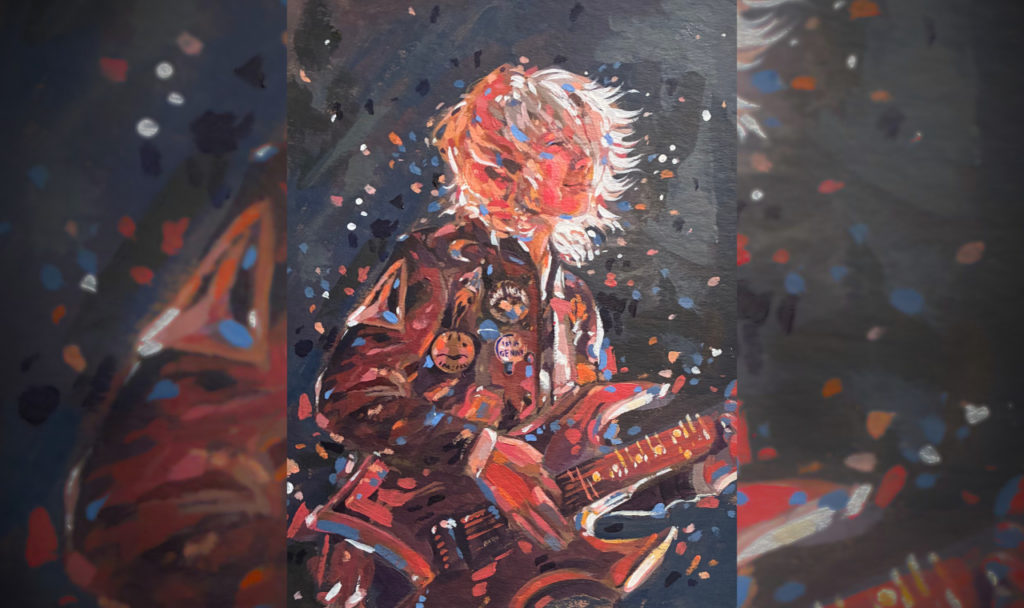
Phoebe Bridgers’ Lost Tour came to Detroit and performed at Little Caesars Arena earlier this month. Two stages, amazing tunes and ethereal lights came together to make for nothing short of a goosebump-inducing experience.
What was missing from the show allowed Phoebe to truly set the stage: for the duration of her show, all phones were locked away.
Why now?
A device-free concert. Is it disabling for the audience or the start of a new social movement?
Indie folk singer-songwriter Phoebe Bridgers has been on The Lost Tour featuring opener Alex G. since Sept. 15, 2026. All shows on this tour (including her Oct. 3 Detroit show) ban the use of phones.
Phones are “locked away” via Yondr cases for the duration of the show.
According to a report from Paste Magazine, the shows are ADA compliant. Medical exemptions can be sought on a case-by-case basis. If there is a need to use your phone while in attendance, unlock stations are located throughout the concourse.
Pre-show thoughts from a concertgoer
While she’s not the first artist to ban phones, Bridgers’ decision has sparked debate online. In the case of onsite emergencies, what are concertgoers supposed to do? I caught up with concertgoer Sarah Shanley before Bridgers’ set to discuss.
Regarding the phone policy of Bridgers’ show, Shanley said she “personally does not have a problem with it,” though she does wish she could get a video or two of the concert for her phone’s camera roll. This was Shanley’s first time attending a device-free show
Shanley understands the reasoning for not having phones. Many of Bridgers’ songs center around her father who died in 2023, which also prompted conversation with the audience throughout the show. Those discussions would not have been held as easily if phones were present.
She added that “as long as venues and artists are willing to accommodate people who need phones for medical reasons” while providing that space for artists, she thinks device-less shows are fine.
At the same time, she acknowledged that no arena show is without safety concerns. Citing Travis Scott’s Astroworld, a show with a crowd surge that caused the death of 10 individuals, she called on event handlers to not oversell venues.
For Shanley, the benefits of a device-free show outweighed the concerns. These shows can provide a space where artists like Bridgers can have vulnerable conversations with audience members, a feature made difficult at shows where cameras are constantly on the artists center stage.
Still, having good security for device free shows is just as important as the uniquely disconnected experiences themselves.
No phone, no problem?
After the show, I spoke with Madeleine Loomis. At concerts Loomis has attended in the past, she’s noticed that people are on their phones pretty consistently. She regarded it as something that very quickly becomes “pretty distracting.”
Regrettably, a phone-less show offers some logistical concerns.
Unfortunately, Loomis was initially given an incorrect wristband and entrance information for her ‘Above GA’ ticket. This caused her to miss the opening act.
“If you don’t have tickets printed out, you have to use your phone…you get the wrong information and then you don’t know where you’re going. They (the event staff) were not able to confirm ticket information.”
Once in the arena people had no choice but to assist their lost peers at The Lost Tour. The entire process for Loomis and co. to find their seats took around an hour, which luckily was right as Bridgers’ set was starting.
‘Lost Boys’ found
The show itself more than made up for the entrance headache, though. Loomis adored seeing how the audience engaged with Bridgers.
For example, at most shows, people usually use their phone’s flashlight during intimate songs. Without phones, the auditorium was pitch black and audience members instead used lighters which Loomis said was “fun to see.” It created a sea of small orange flames that illuminated Bridgers’ night.
This was the first concert Loomis attended that was so strict about being device free.
Since Loomis wasn’t on her phone, she was able to connect a little bit better with others in her section, stating she “met a lot of really cool people” she would not have otherwise at a show permitting cellphones.
Closing thoughts
The phone policy of Bridger’s shows attempts to create an environment of comfort and connection (physically, not digitally). It succeeds. Audience members were fully engaged here. After the show, they were able to capture their memories through recreating what they saw on stage with expressive drawings and paintings.
Around Detroit in Hamtramck at Outer Limits Lounge, El Club in Mexicantown, St. Andrews Hall downtown, or even one of the larger Detroit venues in the Masonic Temple, the issue of phones is twofold.
On one hand, a lack of phone or turning a phone off allows us to fully engage in the intimacy of smaller venues. On the other hand, sharing the moment through social media helps the artist and the venue to gain exposure, something many small stages need to survive.
To keep live music shows alive, there has to be a balance between the tech-free attention of audience members and the digital potential for outreach held by artists alongside the venues they perform in.
Without the availability of digital viewership of Bridgers’ performance, her shows have set a unique precedent for standing side by side those who want to be there not for clicks, but for memories. No phones. No FaceTimes, just time face to face.
Whether or not this means a permanent change for the live entertainment industry going forward remains to be seen. Needless to say, I made a memory that goes well beyond any digital screen.